
Mega Backdoor Roth 2026: Is It Worth It for High Earners? | Sure Horizon Retirement Advisors
A mega backdoor Roth is a strategy that lets you put after-tax dollars into your 401(k) beyond the normal employee deferral limit, then convert those dollars to Roth so they grow tax-free for the rest of your life. In 2026, the employee deferral limit is $24,500, but the total that can flow into your 401(k) from all sources is $72,000, and that gap is the space the strategy fills. It is worth it if your plan actually allows it, you have already funded the basics, and you have cash left over that would otherwise go into a taxable brokerage account.
What is a mega backdoor Roth, in plain English?
Let me define the terms first, because this is one of those strategies where the name does more harm than good. A regular backdoor Roth is a small maneuver involving an IRA, worth about $7,500 a year in 2026. A mega backdoor Roth happens inside your 401(k) at work, and it can be worth five or six times that amount. Same word, completely different plumbing.
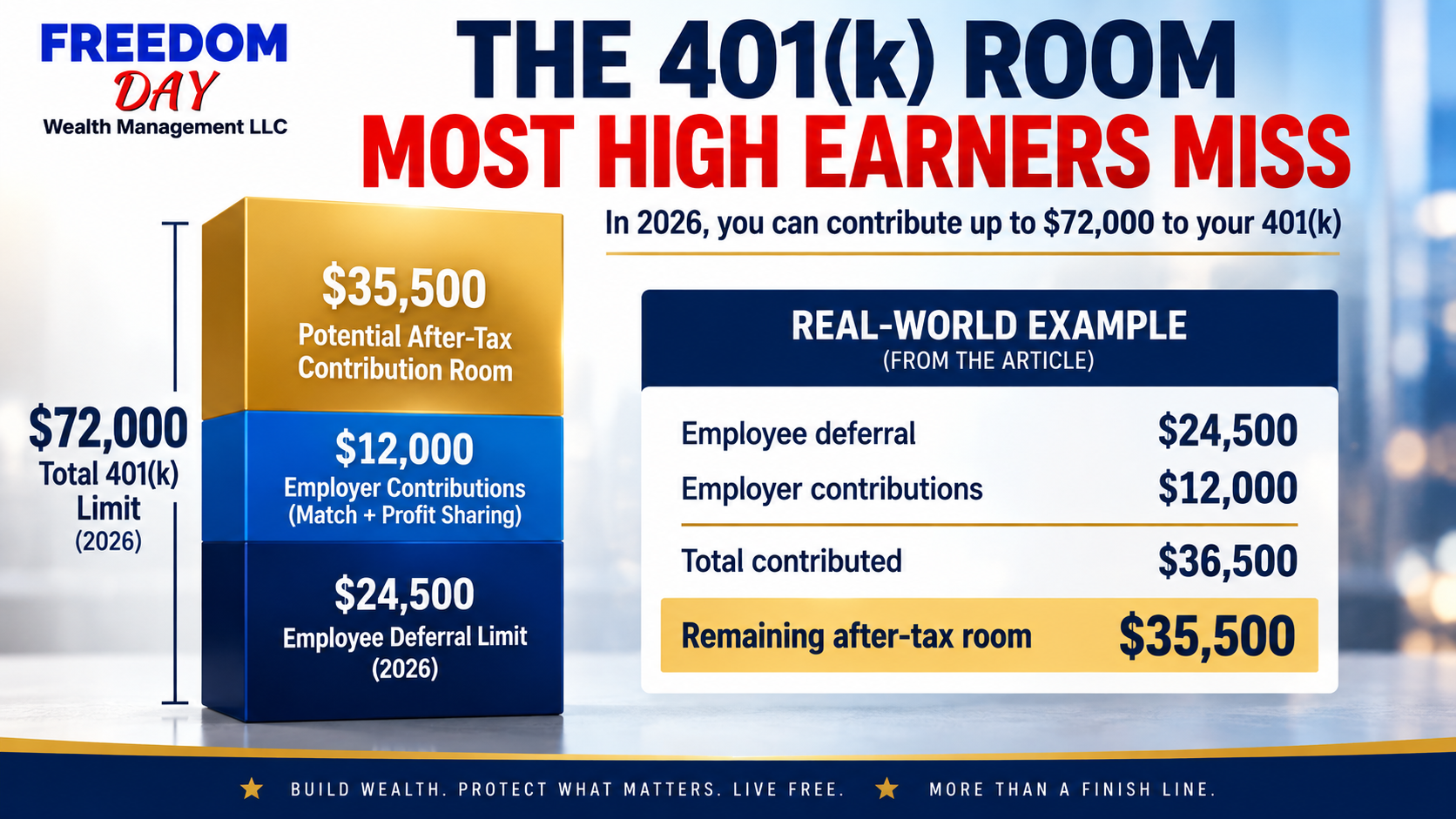
Here is the basic idea. Most people think of a 401(k) as having one limit, the amount they can defer out of their paycheck. In 2026 that number, which the code calls the 402(g) limit, is $24,500, plus $8,000 more if you are 50 or older, or $11,250 if you happen to be 60, 61, 62, or 63. But there is a second, much larger limit sitting above it. Internal Revenue Code Section 415(c) caps the total of everything that goes into your 401(k) in a year, meaning your own deferrals plus the company match plus any profit sharing plus any after-tax money, at $72,000 for 2026. Catch-up contributions sit on top of that number rather than inside it, so a 50-year-old is really working with $80,000 of total room.
Now do the arithmetic that makes this interesting. Suppose you defer the full $24,500 and your employer puts in $12,000 between the match and profit sharing. That is $36,500 of the $72,000 used, which leaves $35,500 of unused room. The mega backdoor Roth is simply the act of filling that remaining room with after-tax contributions from your paycheck, and then immediately converting those after-tax dollars into Roth money. Because you already paid tax on them, the conversion itself generally costs you nothing, and from that moment forward the growth is tax-free.
That is the whole thing. It sounds exotic, but it is really just using a part of your 401(k) that most people never notice is there.
How does the money actually move?
The mechanics matter, because this is where the strategy either works beautifully or creates a headache. There are three steps, and each one depends on your specific plan document.
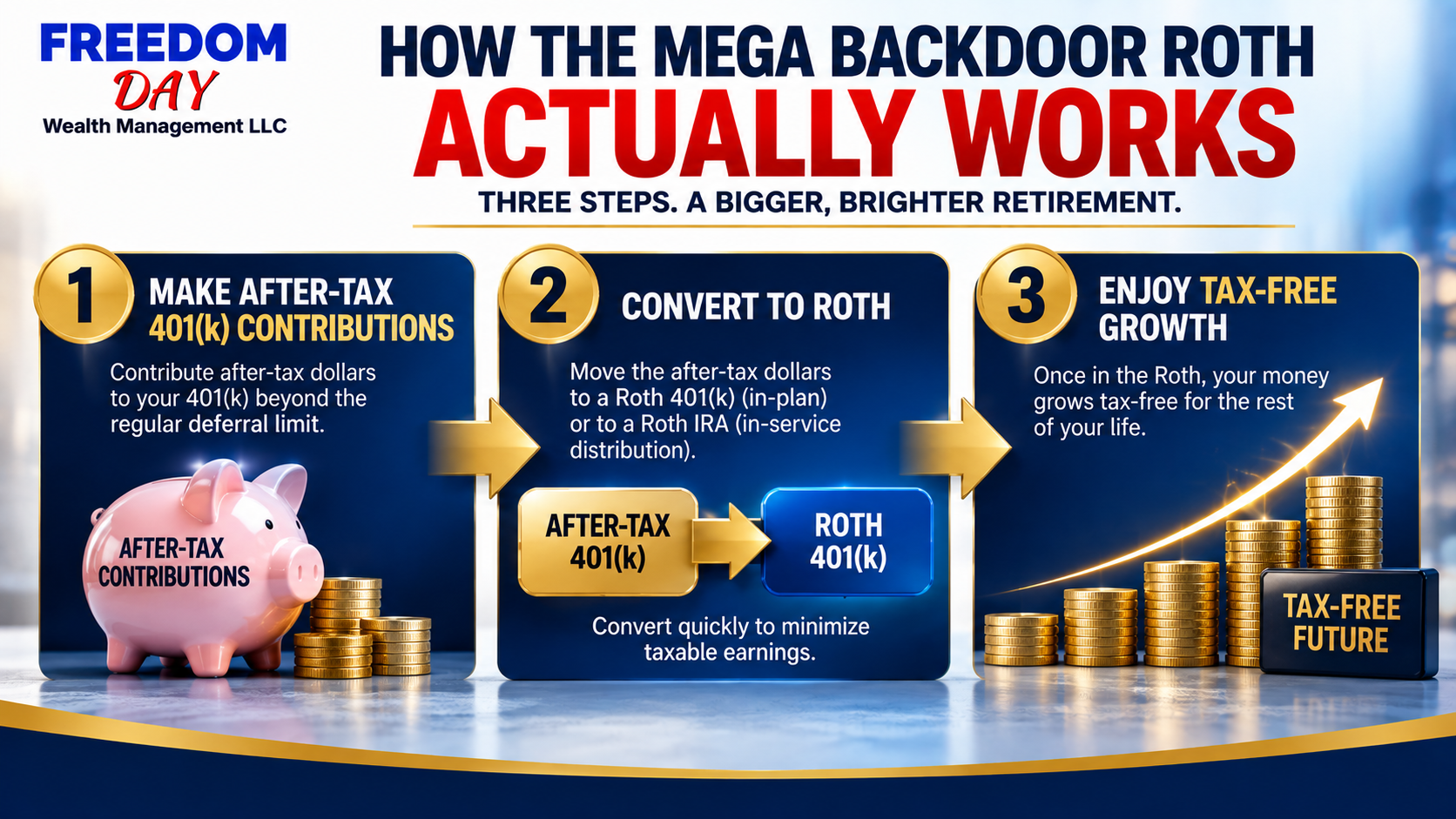
Step one is the after-tax contribution. Your plan has to offer a contribution type that is neither pre-tax nor Roth, but plain after-tax. This confuses people constantly, because Roth contributions are also made with after-tax dollars. They are not the same bucket. Roth deferrals count against the $24,500 limit and grow tax-free. Old-fashioned after-tax contributions do not count against the $24,500 limit; they count against the $72,000 limit, and if you leave them alone, they grow tax-deferred rather than tax-free, which is a mediocre outcome. The after-tax bucket is only useful because of what you do next.
Step two is the conversion. You need a way to turn those after-tax dollars into Roth dollars. Plans handle this one of two ways. Some offer an in-plan Roth conversion, sometimes called an in-plan Roth rollover, which moves the money from the after-tax source into the Roth 401(k) source without it ever leaving the plan. Others offer an in-service distribution, which lets you roll the after-tax money out to a Roth IRA while you are still employed. Either route works. A growing number of plans offer an automatic version, usually called automatic in-plan Roth conversion or daily Roth conversion, where the recordkeeper sweeps every after-tax contribution to Roth within a day or two of the payroll hitting.
Step three is doing it fast. This is where people get it wrong. Your after-tax contributions are already taxed, so converting them is tax-free, but any investment earnings those dollars generate before the conversion are pre-tax money, and converting them creates taxable income in the conversion year. If you contribute after-tax in January and convert in December, you might have a few hundred dollars of growth that shows up as ordinary income on a 1099-R. Not catastrophic, but avoidable. If your plan converts each pay period automatically, the earnings are close to zero, and the whole thing is clean. If you have to call and request the conversion manually, do it every paycheck or, at minimum, every month, and park the after-tax contributions in a money market or stable value option until they convert so they don't generate much in the meantime.
Does your plan even allow it?
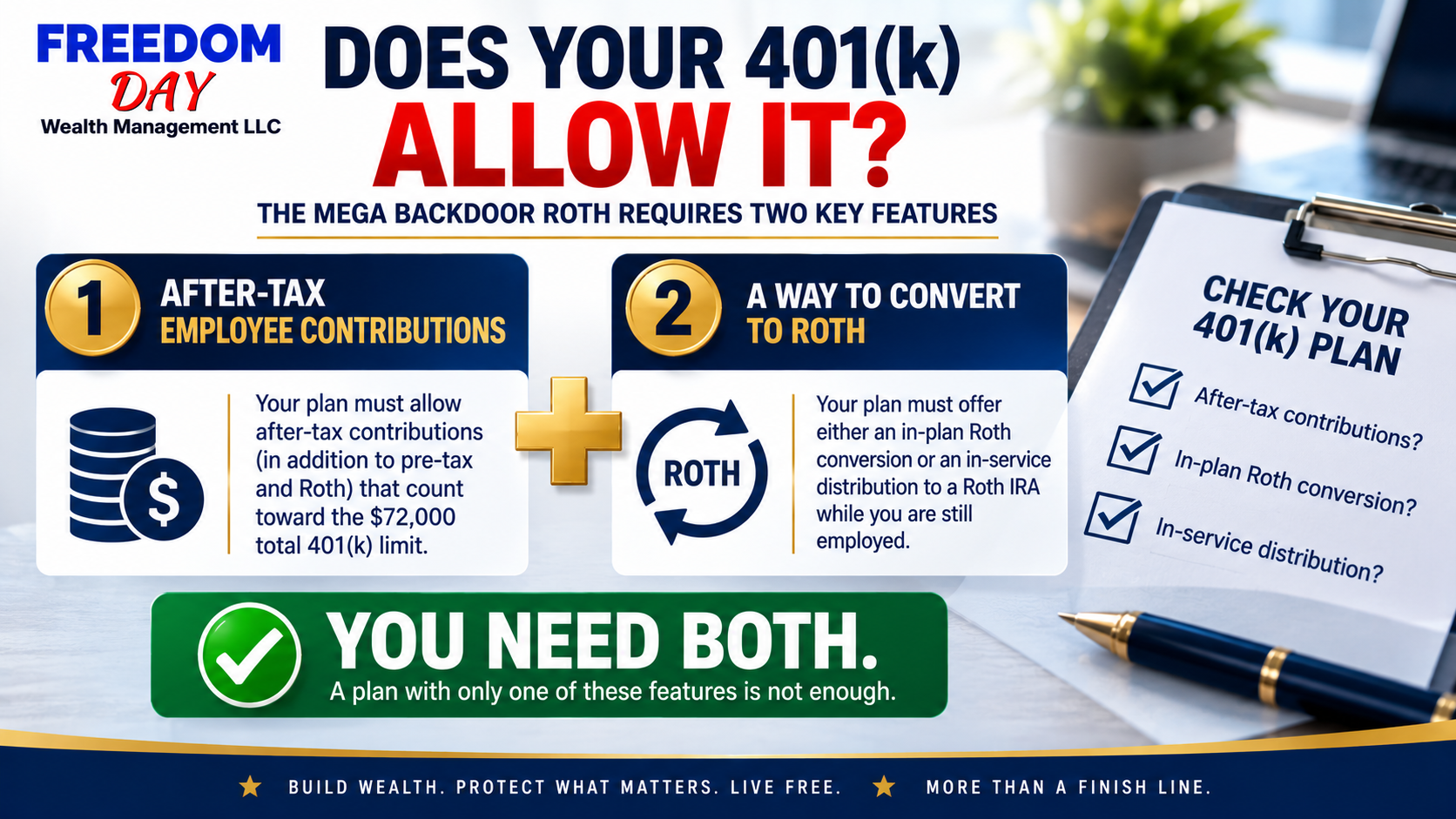
This is the first question to ask, and for a lot of people it ends the conversation right there. The mega backdoor Roth is not a tax loophole you can elect on your own. It is a plan design feature, and your employer has to have built it in.
This is paragraph text. Click it or hit the Manage Text button to change the font, color, size, format, and more. To set up site-wide paragraph and title styles, go to Site Theme.
You need both pieces. A plan that permits after-tax contributions but has no conversion mechanism leaves you with money that grows tax-deferred and comes out partly taxable later, which is generally worse than a taxable brokerage account holding index funds. A plan that permits in-plan Roth conversions but has no after-tax source has nothing to convert. Roughly half of large employer plans support the full combination, and it is far more common in tech, so if you are a senior person at a big technology company, there is a reasonable chance it is sitting right there in your benefits portal under a name you have scrolled past a hundred times.
The fastest way to find out is to open your plan's Summary Plan Description and search for the words "after-tax," then search for "in-plan Roth" or "in-service withdrawal." If the language is ambiguous, call the recordkeeper and ask two specific questions: does the plan accept employee after-tax contributions above the deferral limit, and does it allow in-plan Roth conversion or in-service distribution of those after-tax amounts? Ask those two questions exactly, and you will get a clear answer. Ask "do you offer the mega backdoor Roth," and there is a good chance the person on the phone has no idea what you mean.
One more wrinkle worth knowing. After-tax employee contributions are included in the ACP test, a nondiscrimination test that compares what highly compensated employees contribute against what everyone else contributes. If too few rank-and-file employees use the after-tax feature, the plan can fail the test, and the fix is to refund money to the higher earners after year-end. Some plans manage this by capping after-tax contributions at a percentage of pay well below the theoretical maximum. If your plan tells you you can only contribute 10 percent of pay after tax, that is usually why. It is not a mistake, and it is not negotiable, so plan around the cap rather than fighting it.
How much room do you actually have?
Run the numbers before you decide anything, because the answer is often smaller than the headline suggests. Start with $72,000 for 2026. Subtract your own elective deferrals, whether pre-tax or Roth, which will be $24,500 if you are maxing out. Subtract everything your employer contributes, including the match, any true-up, any profit sharing, and any non-elective contribution. What remains is your theoretical after-tax room, and then you apply whatever percentage-of-pay cap your plan imposes.
A quick hypothetical, and I want to be clear this is an illustration and not a projection of anyone's actual results. Say you earn $400,000 in salary and bonus, you defer the full $24,500, and your company matches 6 percent on the first portion of eligible pay for a total of $14,000. That is $38,500 of the $72,000 consumed, leaving $33,500. If your plan caps after-tax contributions at 10 percent of eligible pay and your eligible pay is $350,000, your cap is $35,000, which is higher than your remaining room, so the 415(c) limit binds and you can do the full $33,500. Change the plan cap to 6 percent, and your ceiling drops to $21,000. Same person, same salary, very different answer, entirely because of plan design.
Two more things go into that calculation. If you are 50 or older, your catch-up contribution does not eat into the $72,000, so it does not reduce your after-tax room. And if you worked at two employers this year, the $24,500 deferral limit follows you personally across both plans, but the $72,000 limit generally applies per employer for unrelated employers, which occasionally creates more room than people expect.
Is it actually worth doing?
Here is where I want to be honest rather than promotional, because the mega backdoor Roth gets written about as though it is free money, and it is not. It is a real benefit with a real cost, and the cost is liquidity.
The benefit is straightforward and it compounds. Money in a taxable brokerage account throws off dividends and interest every year that you pay tax on, and for a senior executive that tax is likely at a 20 percent qualified dividend rate plus the 3.8 percent net investment income tax, with ordinary rates on bond interest. Then you pay capital gains when you sell. Money converted to a Roth pays none of that, ever, as long as you follow the distribution rules. The gap between those two outcomes over fifteen or twenty years is substantial, and the longer the runway, the bigger it gets.
Roth money also does something specific for people in your situation that has nothing to do with the growth rate. It gives you a pool of retirement income that does not show up as income. That matters more than most people realize once you retire. Required minimum distributions on a large pre-tax 401(k) can push you into a higher bracket in your seventies whether you need the money or not. Medicare premiums are set by IRMAA surcharges based on your modified adjusted gross income from two years prior, and the brackets are cliffs, meaning one dollar of extra income can raise your premium for a full year. A Roth bucket you can draw from without generating income lets you manage those thresholds deliberately instead of watching them happen to you.
And for high earners, there is the simple access problem. In 2026, direct Roth IRA contributions phase out between $153,000 and $168,000 of modified adjusted gross income for single filers, and between $242,000 and $252,000 for married couples filing jointly. If you are the executive we are describing, you are well past both. The regular backdoor Roth gets you $7,500. The mega backdoor version can get you five times that or more. For a lot of people it is the only meaningful way to build Roth assets at this stage of a career.
Now the cost. Once the money goes into the 401(k), it is retirement money. Access before 59 and a half generally means penalties and complications, and even the Roth conversion piece carries its own five-year clock for penalty-free access to converted amounts. If you plan to retire at 55 and bridge to Social Security, buy a second home, or pay your kid's tuition, taxable brokerage dollars are the ones you can actually spend without friction. I wouldn't push someone into the last ten thousand dollars of after-tax contributions if it left them short of a comfortable cash position and a taxable account they can access.
There is also an opportunity cost question that is worth thinking through rather than assuming. If you have a concentrated position in company stock, or high-interest debt, or you are not yet funding an HSA, those may deserve the marginal dollar first. The mega backdoor Roth is a great use of surplus savings. It is not a great use of money that should be solving a bigger problem.
Who should do this, and in what order?
Think of it as the last item on a list, not the first. Before you get here, you want the full employer match captured, because that is an immediate return nothing else matches. You want high-interest debt gone and a real emergency reserve in place. You want your HSA funded if you are on a high deductible plan, since it is the only account in the code with a triple tax advantage. You want a clear-eyed decision about pre-tax versus Roth on your regular deferrals, which for someone in the top bracket today usually still favors pre-tax, though it depends on what you expect your retirement income to look like. And you want a plan for any concentrated company stock, because a 40 percent position in one ticker is a bigger risk to your retirement than a tax inefficiency.
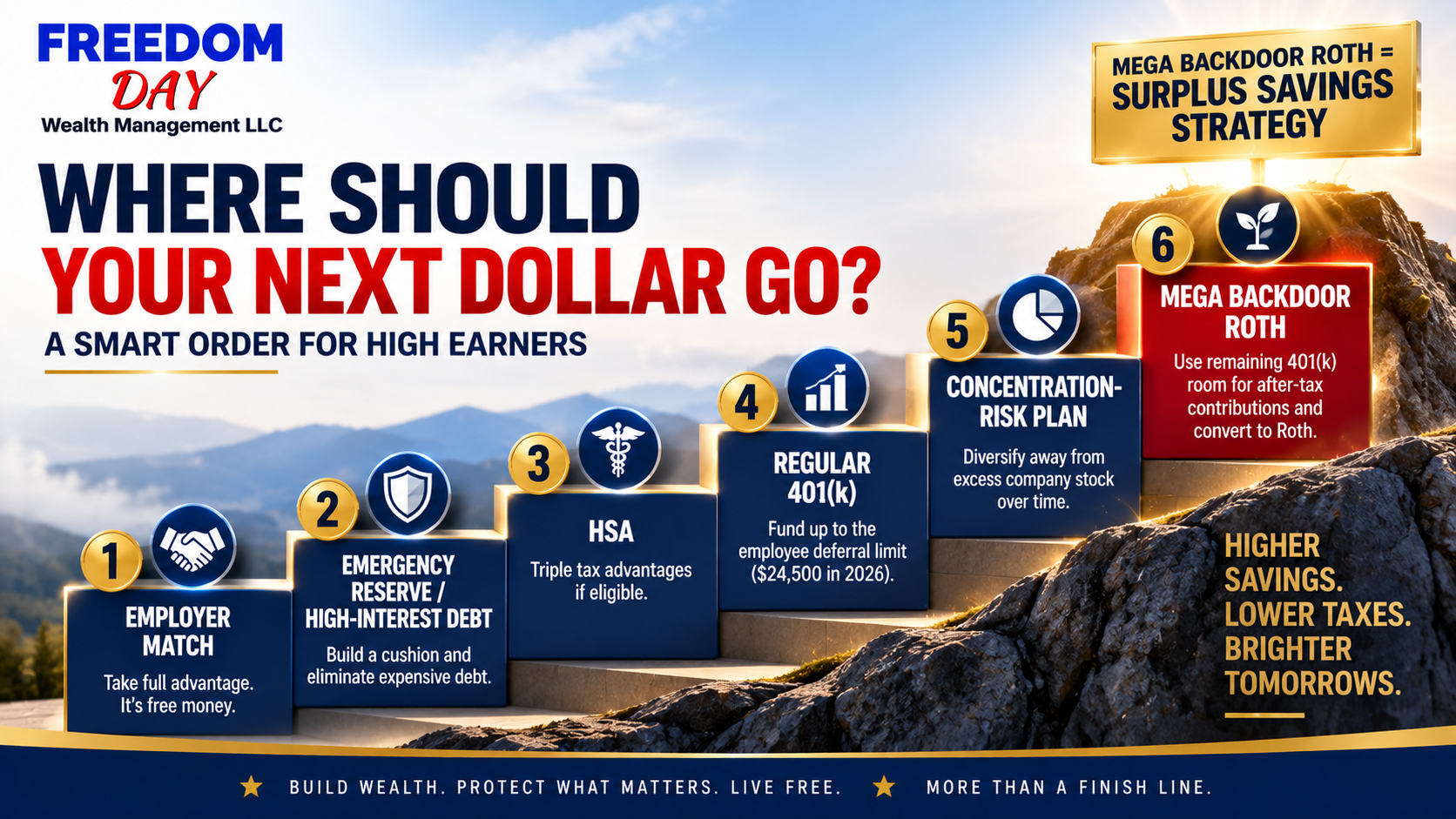
If you've handled all that and still have money piling up in checking every month, the mega backdoor Roth is close to the best thing you can do with it. The ideal candidate has strong cash flow, a plan that supports automatic conversion, at least ten years before they will touch the money, and a taxable account already sufficient for any pre-retirement needs.
The person who should probably skip it is someone whose plan requires a phone call for every conversion, who is likely to forget, and who would end up with a tax-deferred after-tax bucket and a confusing set of basis records. Done badly, this strategy is worse than doing nothing. Done automatically, it is nearly effortless.
What are the common mistakes?
The most frequent one is contributing after-tax dollars and never converting them. People turn on the after-tax election, feel good about it, and never complete step two. Years later they have a sizable after-tax source with a meaningful amount of tax-deferred earnings attached, and every dollar they take out comes pro rata, part tax-free basis and part taxable earnings. The fix is to convert, and the cost is the tax on whatever earnings accumulated. The prevention is to elect automatic conversion the same day you elect the contribution.
The second is front-loading the deferral and losing the match. If your plan does not offer a true-up, hitting the $24,500 deferral limit in June means no match for the rest of the year. That is a direct loss, and it also changes your 415(c) math. Check whether your plan trues up before you accelerate anything.
The third is confusing the buckets. Electing Roth 401(k) deferrals when you meant to elect after-tax contributions is easy to do in a benefits portal, and it produces a completely different result. Read the labels carefully, and confirm on your next pay statement that the money landed in the source you intended.
The fourth is ignoring the plan cap. People calculate their 415(c) room, elect a contribution percentage that would get them there, and then find their contributions cut off in October because the plan limits after-tax to a percentage of pay. Ask for the cap up front and spread the contributions across the full year.
The fifth is forgetting about it when you leave. When you separate from the company, you need to handle the after-tax source and its earnings deliberately in the rollover, with the basis going to a Roth IRA and any pre-tax earnings going to a traditional IRA or being converted intentionally. That is a well-established process, but it only works if someone tells the recordkeeper how to split the distribution. Nobody will do it for you.
What should you actually do next?
Pull up your Summary Plan Description this week and look for the two features. If they are both there, log into the recordkeeper and check whether automatic in-plan Roth conversion is available, and turn it on. Then work out your real number for the rest of the year: $72,000 minus your deferrals to date, minus projected employer contributions, held against whatever percentage cap your plan imposes. Set the after-tax election at a level that spreads evenly across the remaining paychecks, and verify on the next pay stub that the money went where you expected.
If your plan does not offer these features, it is worth asking. Human resources and benefits teams at large companies field these requests, and after-tax contributions with automatic Roth conversion have become a fairly standard competitive feature. You will not get an answer this year, but plan designs do change, and the people who ask are the reason they change.
And if you are not sure whether the marginal dollar belongs here at all, that is the right question to be asking. The mega backdoor Roth is a very good tool for surplus savings in the last stretch of a high-earning career. The work is figuring out whether the money in front of you is actually surplus.
Key takeaways
- A mega backdoor Roth uses after-tax 401(k) contributions plus a Roth conversion to build tax-free retirement money well beyond the normal deferral limit.
- For 2026, the employee deferral limit is $24,500, the total annual additions limit under Section 415(c) is $72,000, and the space between them, after subtracting employer contributions, is your after-tax room.
- Catch-up contributions of $8,000 at age 50 and older, or $11,250 at ages 60 through 63, sit on top of the $72,000 limit rather than inside it.
- The strategy requires two separate plan features: employee after-tax contributions, and either in-plan Roth conversion or in-service distribution. Both must be present.
- Convert quickly, ideally automatically each pay period, because earnings that accumulate in the after-tax bucket before conversion become taxable income when converted.
- Plan-level ACP testing often caps after-tax contributions at a percentage of pay below the theoretical maximum, so confirm your actual cap before you plan around the full number.
- The main cost is liquidity. This money is locked into retirement accounts, so fund your cash reserve and taxable account needs first.
- Roth dollars are valuable for more than tax-free growth. They create retirement income that does not count toward RMD pressure or Medicare IRMAA thresholds.
- Beginning in 2026, catch-up contributions must be made as Roth contributions if your prior-year FICA wages from that employer exceeded $150,000, which is a separate rule but one most executives reading this will be subject to.
Frequently asked questions
What is the difference between a backdoor Roth and a mega backdoor Roth? A backdoor Roth involves contributing to a traditional IRA and converting it to a Roth IRA, which is capped at the IRA contribution limit of $7,500 for 2026, plus $1,100 if you are 50 or older. A mega backdoor Roth happens inside a 401(k), uses after-tax plan contributions rather than IRA contributions, and can move tens of thousands of dollars per year depending on your plan and your employer's contributions. They are separate strategies, and you can do both in the same year.
How do I know if my 401(k) allows a mega backdoor Roth? Check your Summary Plan Description for two specific features: employee after-tax contributions that are separate from pre-tax and Roth deferrals, and either an in-plan Roth conversion or an in-service distribution of after-tax amounts. If the document is unclear, call your recordkeeper and ask about those two features by name rather than the mega backdoor Roth, an informal term many service representatives will not recognize.
Do I pay tax when I convert the after-tax money to Roth? You generally pay no tax on the contributions themselves, because you already paid tax on those dollars. You do pay ordinary income tax on any investment earnings that accumulated in the after-tax bucket between the contribution and the conversion. This is why converting immediately, or at least frequently, matters so much, and why many people hold after-tax contributions in a conservative option until the conversion occurs.
Does the mega backdoor Roth reduce my current tax bill? No. After-tax contributions provide no current deduction, so your taxable income stays unchanged this year. The benefit is entirely future-facing: tax-free growth, tax-free qualified withdrawals, and retirement income that does not raise your adjusted gross income. If your goal is to lower this year's taxes, pre-tax deferrals and an HSA do that, and this strategy does not.
Can I still do this if I am over the Roth IRA income limits? Yes, and that is much of the point. The income phase-outs that apply to direct Roth IRA contributions, which for 2026 run from $153,000 to $168,000 for single filers and $242,000 to $252,000 for joint filers, do not apply to after-tax 401(k) contributions or to Roth conversions. High income does not disqualify you from this strategy. Only your plan's design can.
What happens to the money if I leave the company? When you separate, you can roll the after-tax basis to a Roth IRA and any associated pre-tax earnings to a traditional IRA, or convert those earnings and pay the tax deliberately. Any amounts already converted to Roth inside the plan roll to a Roth IRA. The important step is telling the recordkeeper how to split the distribution, because the sources need to be directed separately and the default handling is not always what you want.
Do I need to worry about a five-year rule? Yes, and there are two. Your Roth IRA has a five-year clock that starts with your first contribution to any Roth IRA and governs whether earnings come out tax-free. Amounts converted to Roth have their own five-year clock for penalty-free access to the converted principal before age 59 and a half. Neither is usually an obstacle for someone who is ten years from retirement, but they are worth understanding before you plan to spend the money early.
About Jeff Kikel
Jeff Kikel is the founder of Sure Horizon Retirement Advisors and the President and Chief Investment Advisor, a fee-based wealth and retirement planning firm that helps senior professionals and executives turn a career's worth of equity compensation and savings into a confident, well-planned retirement. Jeff writes and speaks in plain language because he believes people make better decisions when they actually understand what is happening with their money. His approach is simple: explain the tradeoffs honestly, keep the focus on the long term, and always circle back to what you should actually do next.
If you are a high earner trying to figure out where the next dollar of savings should go, and whether your 401(k) has room you are not using, Sure Horizon Retirement can help you map it out alongside your equity compensation and your retirement timeline. You can learn more at
www.surehorizonretirement.com.
This article is for educational purposes only and is not investment, tax, or legal advice. Every situation is different, and the rules and dollar limits referenced here can change. Please consult a qualified financial or tax professional, and review your own plan documents, before making contribution or conversion decisions.
Sources
- IRS: 401(k) limit increases to $24,500 for 2026, IRA limit increases to $7,500
- Current Federal Tax Developments: Analysis of Notice 2025-67 for 2026
- KPMG: Notice 2025-67, increased retirement plan contribution limits for 2026
- Ascensus: IRS Releases 2026 Cost-of-Living Adjusted Retirement Savings Limitations
- IRS Issue Snapshot: Fixing common plan mistakes, failure to limit contributions for a participant
- Newfront: 401(k)ology, IRC Section 415(c) Annual Additions Limitation
- Employee Fiduciary: The 415(c) Limit For 401(k) Plans, FAQs for Employers
- ASPPA: Roth Catch-Up Contributions, Final Regulations and 415(c) Interactions
- Trucker Huss: The Roth Catch-Up Regulations are Final
- Newfront: Final SECURE 2.0 Catch-up Regulations, Highlights to Know
- Charles Schwab: What Is a Mega Backdoor Roth Strategy?
- Fidelity: What is a mega backdoor Roth?
- Vanguard: Roth IRA income and contribution limits